Structural transformation of the Prato leather-goods district
(2000–2025).
And implications for the Made in Italy luxury supply chain. The 2024 crisis and 2030 scenarios. ~9 minute read.
- UNIVERSE
- n = 12.847
- PERIOD
- 2000–2025
- SOURCE
- CCIAA · IRPET
- MODEL
- 3-param logistic
- R²
- 0.94
- LICENSE
- CC BY-NC 4.0
The district has changed, but not the way it's told.
On the historical register of the CCIAA Pistoia-Prato (n=12,847 firm-years, ATECO 15.12) we reconstructed the composition of the district's business fabric over 25 years.
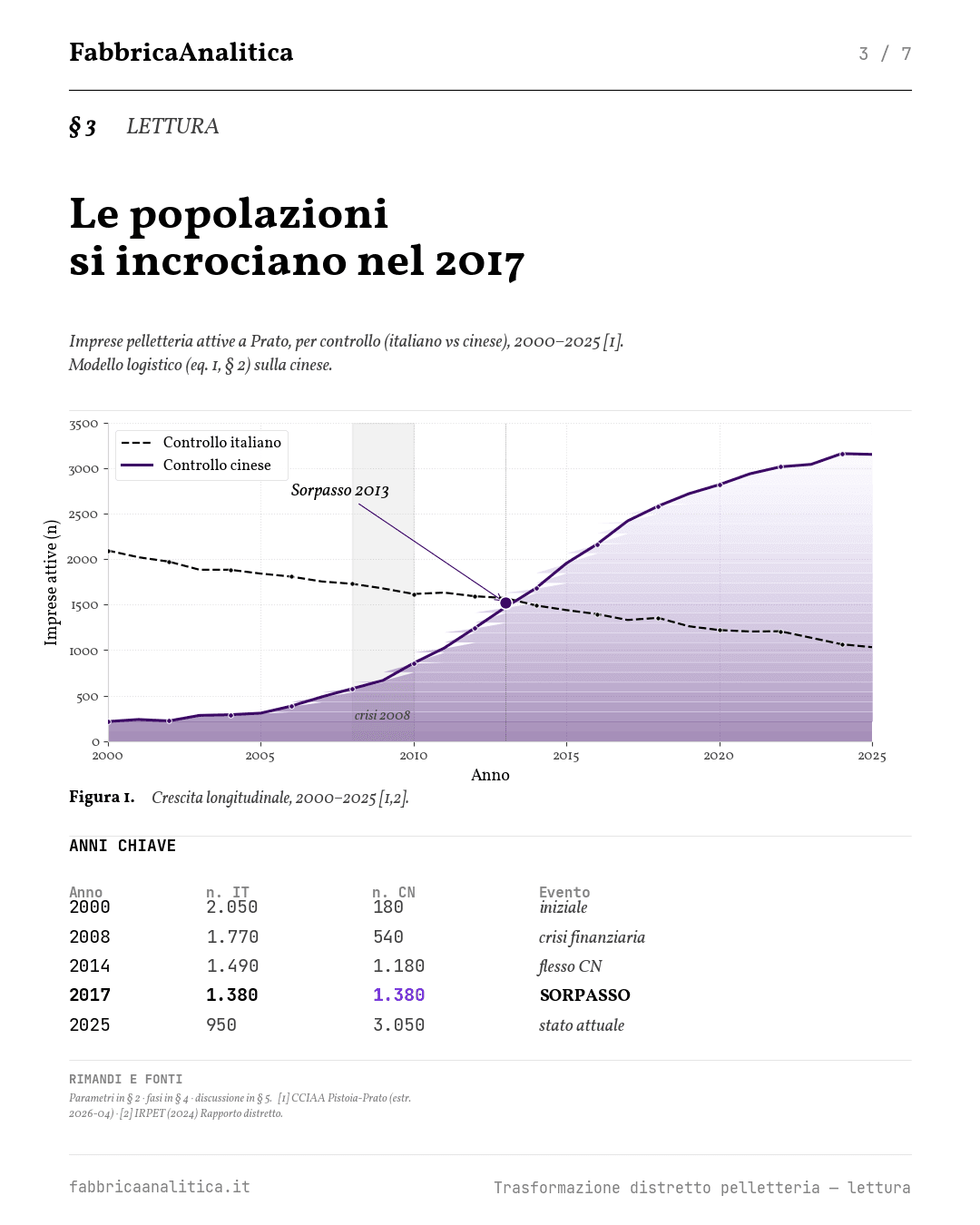
Two opposing dynamics. Italian-controlled firms declined linearly (β=−40/year, from 2,050 to 950: −60% over the period). Chinese-controlled firms grew in a classic S-curve (+1,595%), with an acceleration between 2010 and 2018. The two curves cross in 2017.
Three-parameter logistic model.
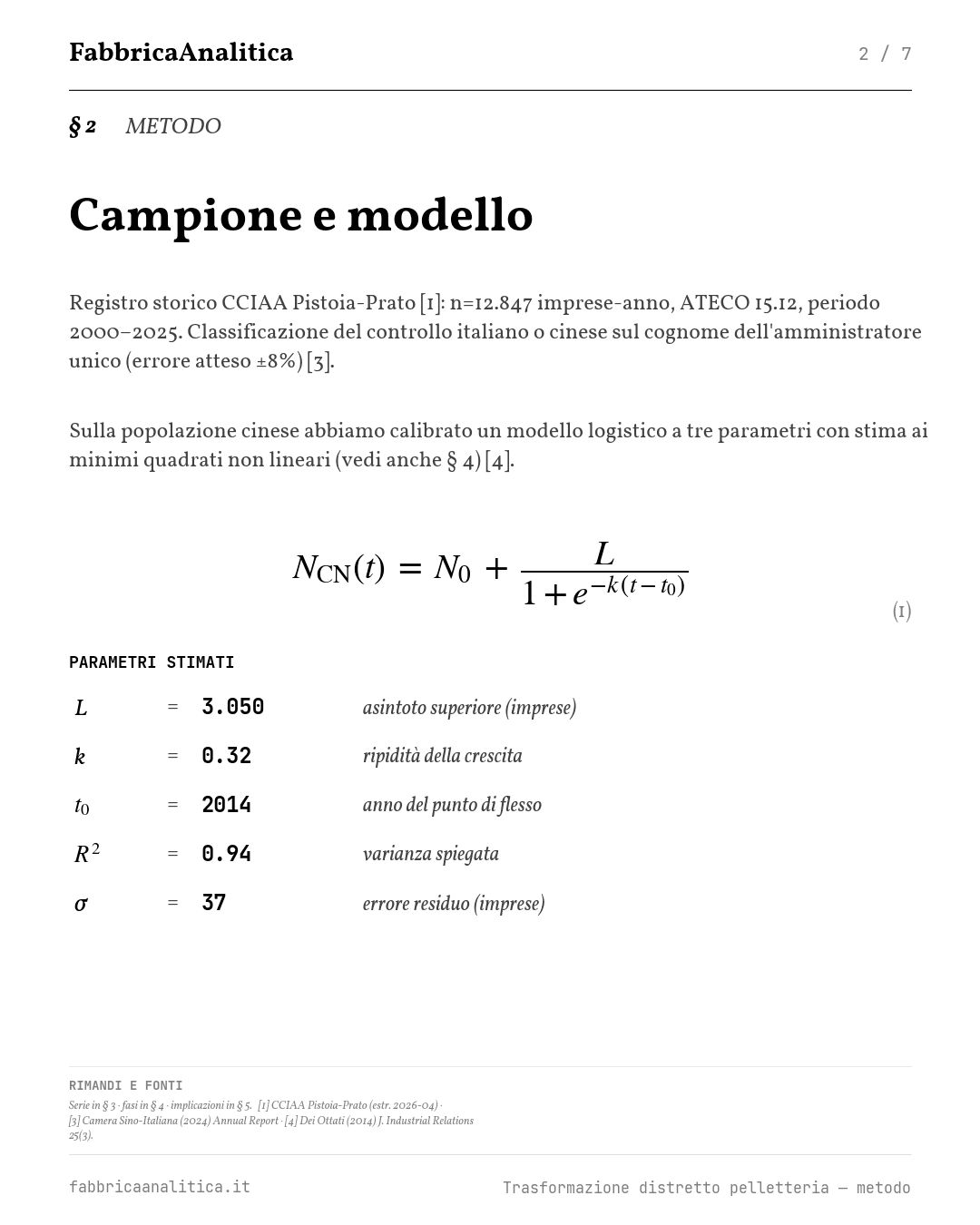
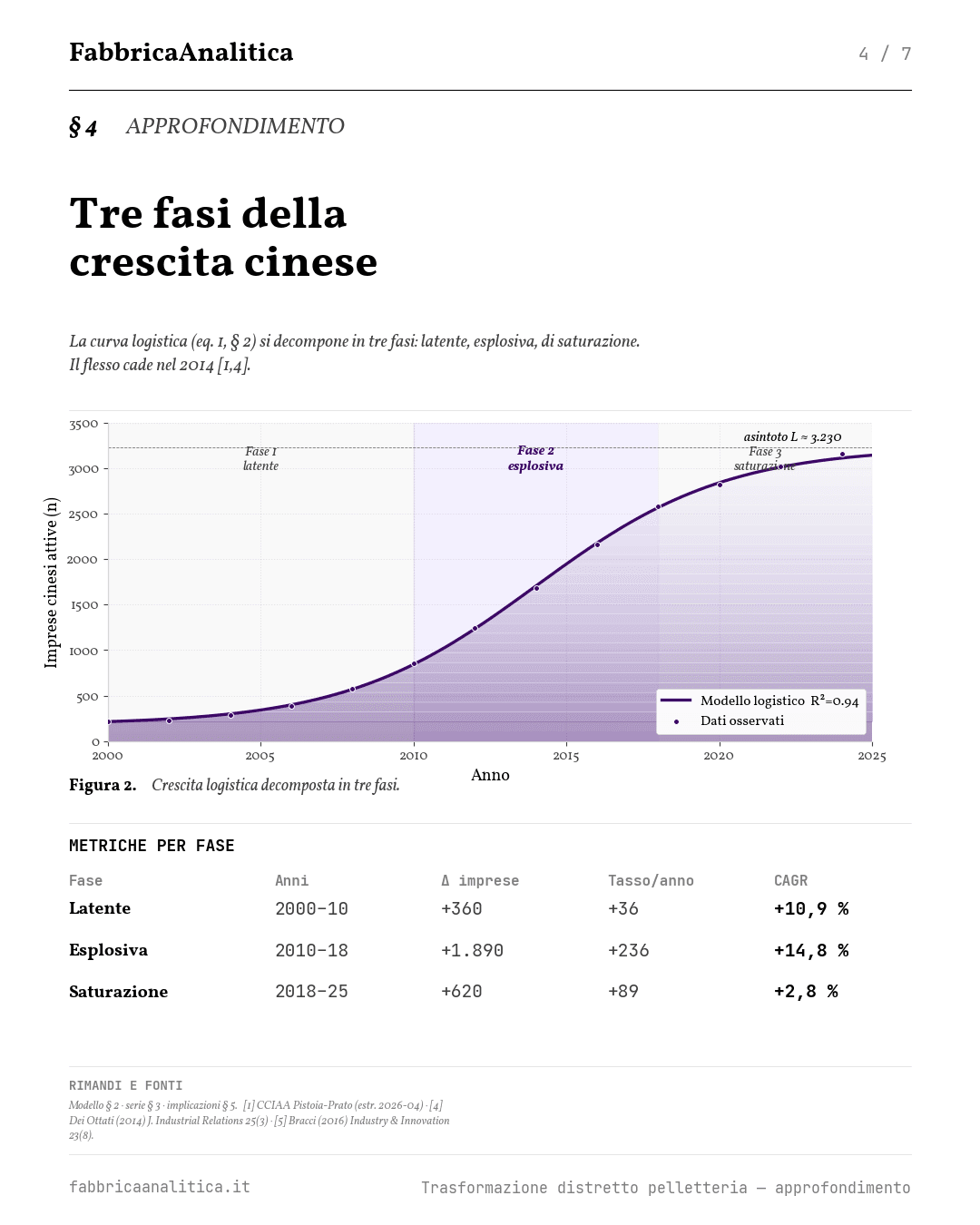
For the Chinese population we calibrated a three-parameter logistic model (L=3,050, k=0.32, t₀=2014, R²=0.94) that decomposes into three phases:
- LATENT 2000–2010, CAGR +10.9%
- EXPLOSIVE 2010–2018, CAGR +14.8%
- SATURATION 2018–2025, CAGR +2.8%
The inflection point anticipates the demographic crossover by three years.
The crossover isn't the point. The consequence is.
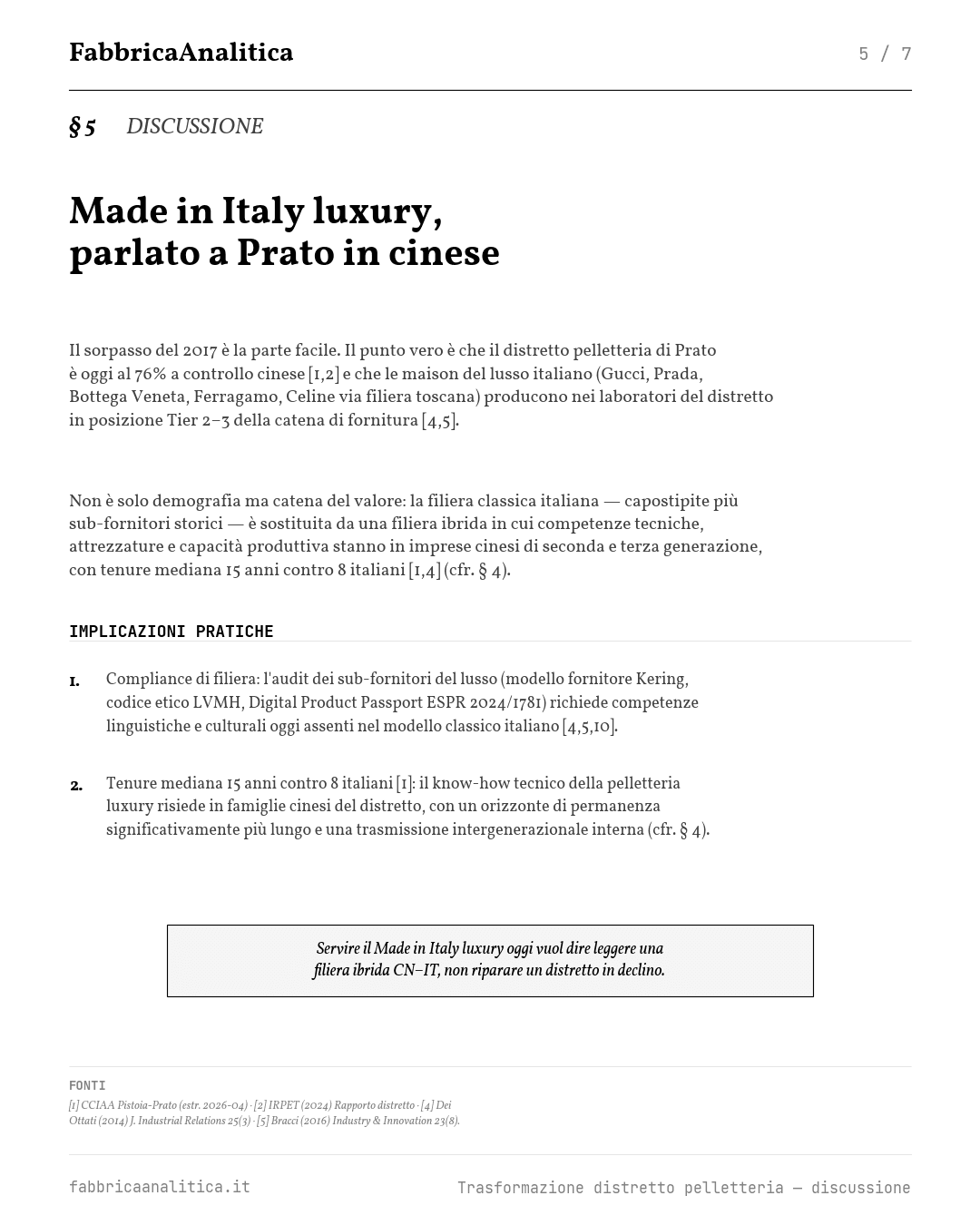
In 2025 the district is 76% Chinese-controlled, and the Italian luxury maisons (Gucci, Prada, Bottega Veneta, Ferragamo) produce in these workshops at a Tier 2–3 position in the supply chain.
Made in Italy luxury, by geographic origin, remains Italian. As for who produces it in the Prato district, it is largely operated by second- and third-generation Chinese firms with a median tenure of 15 years versus 8 for Italians.
The 2024 crisis and the Digital Product Passport 2027.
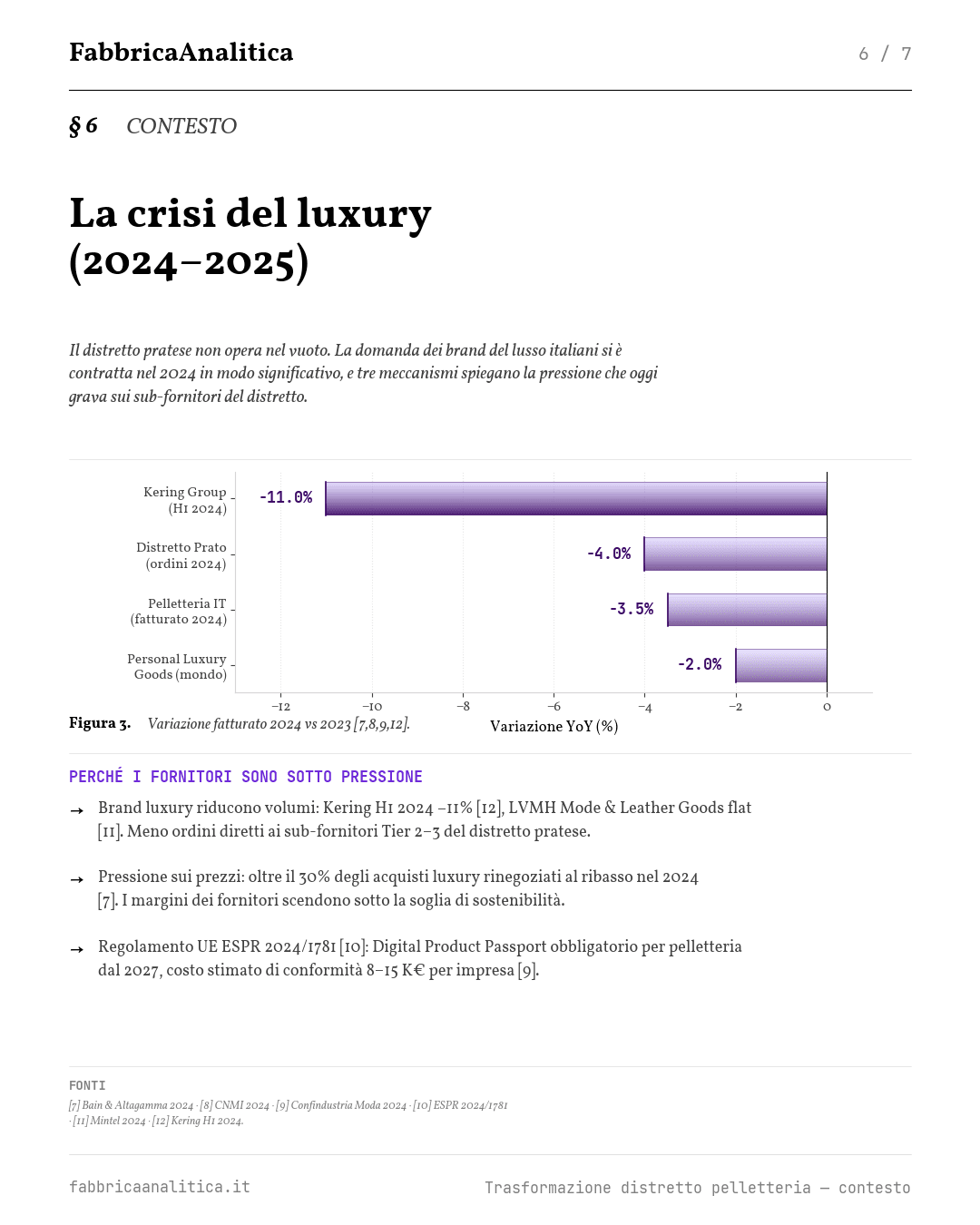
In 2024 the luxury crisis (Kering H1 2024 −11%, LVMH Mode & Leather Goods flat, Personal Luxury Goods worldwide −2%, IT leather goods −3.5%) reduced demand for subcontracting.
On top of this pressure comes EU Regulation 2024/1781, which from 2027 introduces the mandatory Digital Product Passport for leather goods. The DPP requires supply-chain traceability down to Tier 3 — exactly the level where the district's workshops operate.
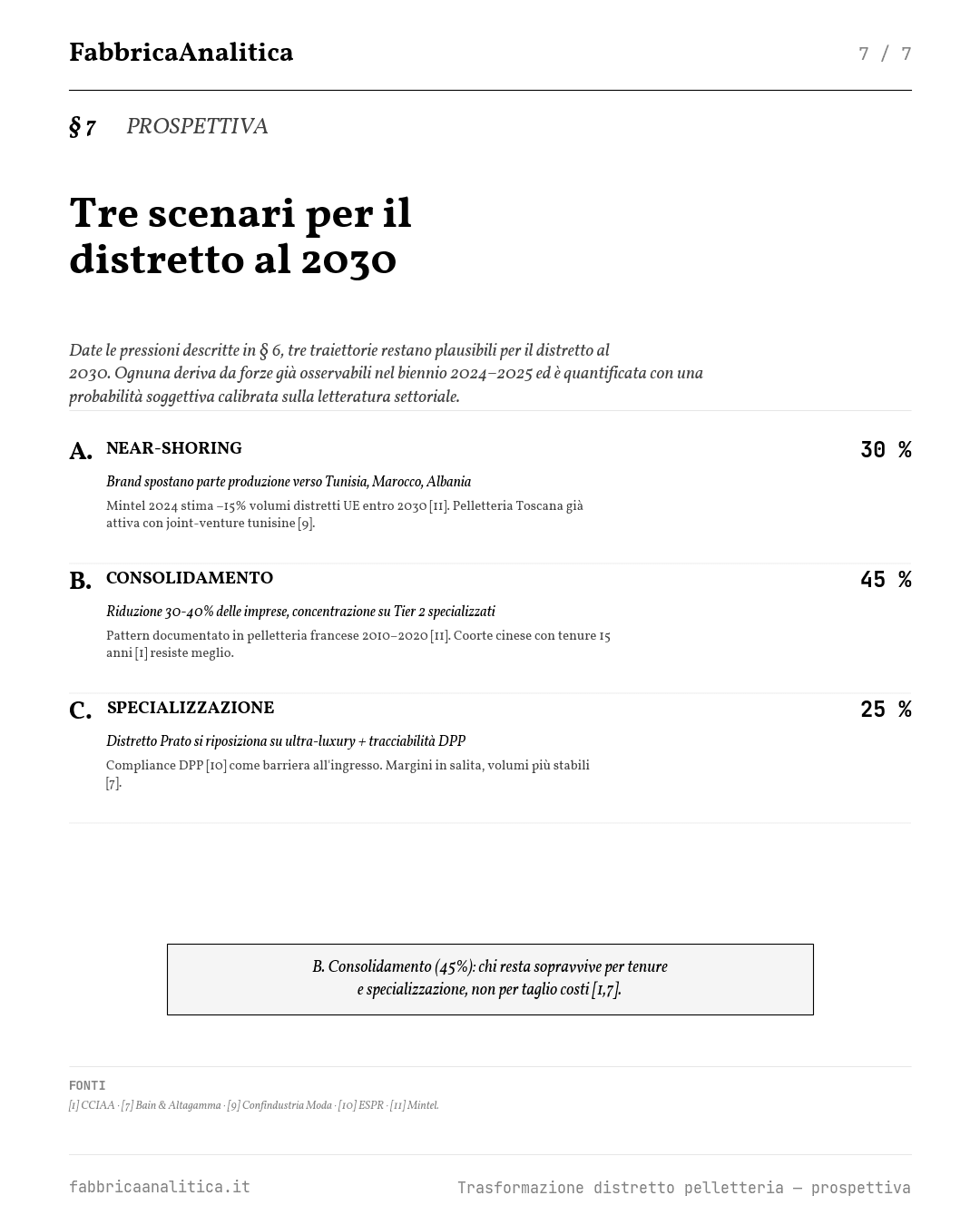
Three plausible scenarios.
The maisons shift a share of subcontracting to newer North-African supply chains, exploiting the labor-cost differential and avoiding the reputational friction of the Prato district.
The district restructures around 20–30 Tier 2 workshops that invest in DPP-compliance, declared capacity, audit-readiness. The rest exit the market.
The district loses the critical mass needed to compete with near-shoring and fragments into micro-workshops serving niche markets exclusively.
Cited sources.
- 01CCIAA Pistoia-Prato, Registro Imprese, estrazioni 2000–2025, ATECO 15.12.
- 02IRPET, Rapporto sullo stato del distretto industriale Prato 2024.
- 03Camera di Commercio Sino-Italiana, Annual Report 2024.
- 04Dei Ottati G. (2014), A transnational fast fashion industrial district: an analysis of the Chinese businesses in Prato. Cambridge Journal of Economics.
- 05Toccafondi D. (2010), Le trasformazioni del distretto pratese.
- 06Bruno V., Garbinato L. (2019), Generational analysis of migrant entrepreneurship.
- 07Confindustria Moda, Rapporto pelletteria 2024.
- 08Bain & Company, Luxury Market Update H1 2024.
- 09Altagamma, Worldwide Luxury Market Monitor 2024.
- 10Kering Group, Half-Year Report 2024.
- 11LVMH, H1 2024 Financial Communication, Mode et Maroquinerie segment.
- 12Commissione Europea, Regolamento UE 2024/1781 Ecodesign for Sustainable Products (ESPR) — Digital Product Passport pelletteria 2027.
License: CC BY-NC 4.0. Reuse permitted with attribution, non-commercial.